Page Content
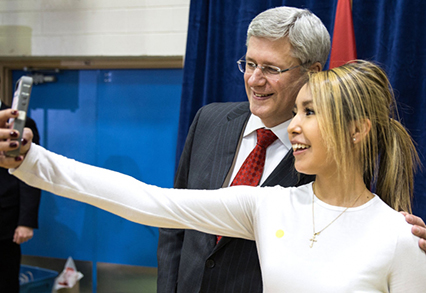
A historic agreement between the Government of Canada and the Assembly of First Nations promises to reform the First Nations K–12 education system through the First Nations Control of First Nations Education Act. Prime Minister Stephen Harper announced the agreement February 7 in Standoff, Alberta.
The legislation, expected to be tabled in Parliament in the coming months, will provide First Nations students on reserve across Canada with the education standards, supports and opportunities that most Canadians take for granted. Acknowledging that First Nations are best placed to control First Nations education, the legislation will recognize the responsibility and accountability of First Nations to administer their education system on reserve. At the same time, the legislation will establish a stable and predictable statutory funding regime that accounts for linguistic and cultural programming.
For example, the legislation will require that First Nations schools teach a core curriculum that meets or exceeds provincial standards, that students meet minimum attendance requirements, that teachers are properly certificated and that First Nations schools award widely recognized diplomas or certificates. The current absence of these requirements has resulted in situations where First Nations graduates cannot demonstrate a recognizable diploma to a workplace or postsecondary institution, forcing them to return to school.
The legislation will also allow for the establishment of First Nations education authorities. These authorities will act like school boards in the provincial education system to provide the key secondary support to help ensure that First Nations schools are meeting their requirements under the act and are providing a quality education for First Nations students.
Most significant, the legislation will outline the federal government’s commitment to adequate, stable, predictable and sustainable funding for First Nations education. This funding will replace the complex structures now in place with just three funding streams:
- A statutory funding stream with a reasonable rate of growth ($1.25 billion over three years, beginning in 2016/17 and increasing 4.5 per cent every year thereafter)
- Transition funding to support the new legislative framework ($160 million over four years, beginning in 2015/16)
- Funding for long-term investments in on-reserve school infrastructure ($500 million over seven years, beginning in 2015/16 when the commitments in the 2012/13 federal budget expire)
“Our government firmly believes that First Nations students across Canada deserve access to a school system with the structure and supports that are available to non-First Nations students across Canada,” said Harper. “This bill is good for First Nations, it is good for Canadians and it is good for our country’s future.”
“Today is about the beginning of a new era of fairness, opportunity and hope for First Nations children, youth and students,” said Shawn A-in-chut Atleo, national chief of the Assembly of First Nations. “Today is a victory for First Nations leaders and citizens who have for decades, indeed since the first generation of residential school survivors, called for First Nations control of First Nations education. The approach we are announcing today embraces the essential and connected components of First Nations control of First Nations education founded on our rights, jurisdiction and treaties; and secure, sustainable and fair funding that supports our students’ success and strengthens their languages and cultures. First Nations control of First Nations education as envisioned by our leaders and educators for many decades will enable and support the systems and standards necessary to ensure our children are nurtured to achieve their goals through full access to quality education.”
The federal government followed through on its funding commitments in the 2014 federal budget, released February 11. The budget confirms core funding of $1.25 billion over three years, transition funding of $160 million over four years and infrastructure funding of $500 million over seven years.
“We welcome this necessary investment to support our new way forward toward First Nations control of First Nations education,” Atleo said. “This is new funding that is now secured in the federal budget. This will help close the gap and support fairness and success for First Nations children and students.”
Not everyone shared that enthusiasm. Speaking on behalf of Treaty 8 First Nations of Alberta, which represents 39 First Nations communities in northern Alberta, Rose Laboucan, chief of the education portfolio, expressed disappointment that the proposed First Nations Control of First Nations Education Act would not become effective until 2016, following the next federal election.
“I am sure I am not the only one wondering if this will fall off the table like the Kelowna Accord,” she said. “Our children need better learning environments and quality lessons now, not years from now. Classrooms in furnace rooms and basements are appalling and unacceptable for anyone’s children. Our teachers’ salaries are below the Canadian average. There have been many inequities going on for years.”
Patrick Loyer, an executive staff officer of the Alberta Teachers’ Association, concurs. However, once the act is proclaimed and the funding is in place, the province’s “reserve teachers should be on par with their Alberta counterparts,” he says. He adds that the provision requiring teachers in First Nations schools to be certificated is probably irrelevant in Alberta as they already have to be certificated.
Allowing for the establishment of First Nations education authorities within the provincial education system could have membership implications as well. Under the Teaching Profession Act, “the employment of a teacher by a school board is conditional on the teacher being and continuing to be an active member of the [A]ssociation,” with some exceptions. A board is defined in the School Act as “a board of trustees of a district or division,” including francophone education authorities, and is similarly defined in the as-yet-unproclaimed Education Act. Presumably, any First Nations education authorities established in Alberta would be defined as boards, and their teachers would be active members of the Association.
Loyer describes that scenario as “a huge plus.” It will give First Nations teachers access to professional development resources and opportunities, such as teachers’ conventions, that they have not always enjoyed in the past. Some First Nations communities, particularly in northern Alberta, are “often little islands unto themselves,” and the Association cannot readily provide them with professional development, he says.
The agreement was reached following a 14-month consultation and discussion period with First Nations leaders, parents, educators and others. The federal government will continue to work with First Nations to finalize the First Nations Control of First Nations Education Act and to develop the act’s regulations.
In 2012/13, close to 10,000 First Nations students attended federally funded schools in Alberta. ❚